Michelle Wang
software engineer building at the intersection of biotech and physical AI.
systems design engineering @ waterloo · new grad 2027
previously interface (sf), resq, private ai
Project Feature
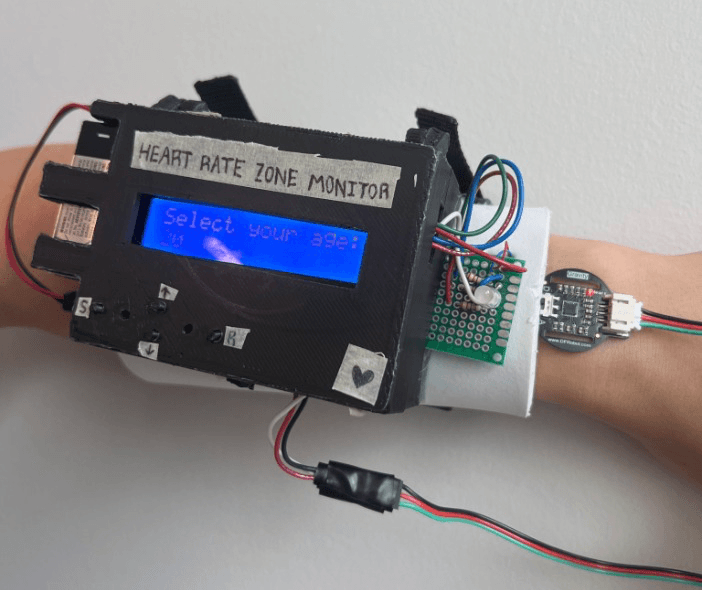
Heart Rate Zone Indicator
embedded · arduino · fusion 360 · pcb design
A forearm-worn device that reads your heart rate and calls the zone in real time: a five-colour LED, a haptic buzz on every change, and an LCD readout. No phone needed.
Karvonen zones off a Tanaka max HR, holding ±2.5 BPM against an Apple Watch on under $100 of parts. Built with a six-person team, I designed the foam brace and the Fusion 360 enclosure.
##About
I study Systems Design Engineering at Waterloo, a degree that spends as much time on sensors, signals, and control as it does on software. Across six internships, I've focused on backend infrastructure and AI systems: high-throughput retrieval, LLM pipelines, and real-time services that can't drop calls.
Now, I want to direct that towards the physical world. The problems I care about sit at the boundary of hardware, biotech, and AI: wearables, physical AI, and accelerating biological research. That's what I want to work on after graduation, and what I'm building toward in the meantime.
##Projects
Cochlear Implant Signal Processor
Python pipeline that simulates how a cochlear implant hears: a log-spaced Butterworth IIR filter bank splits 100 Hz–8 kHz into 24 channels, then rectification and lowpass envelope extraction amplitude-modulate a carrier tone per band. Swept 1848 configurations against PESQ, SNR, and frequency retention, then ran listener tests on the top three.
Body Impedance Scale
Analog front end for a bioimpedance measurement, built for my SYDE circuits and instrumentation final lab. Voltage follower for impedance matching into cascaded second-order low-pass, high-pass, and bandpass stages, characterized against measured Bode plots out to 80 kHz.
Human Transporter Model
Dynamic model of a self-balancing two-wheeled transporter, treated as a planar inverted pendulum. Derived the equations of motion from free-body diagrams, linearized them into a state-space model solved in Simulink with tip detection, then tuned a 3D SimulationX build (friction, rolling resistance, lean angle, thrust) from 10 m before tipping to 42 m.
Jasmine AI
Multilingual AI agent for a real-estate platform. Designed the Postgres schema and SQLAlchemy APIs, and led a 3-engineer team building the Next.js/Python app.
sign:here
A React chatbot that makes complex legal documents easier to understand and navigate, powered by Cohere NLP and Flask, with semantic and vector search via Qdrant.
write:here
Next.js app that pulls text out of photos with Google Vision OCR and turns it into a ready-to-send email. Won Most Creative Use of GitHub at Hackville.
##Experience
Software Engineer Intern · Interface
May 2026 – Aug. 2026San Francisco, CA · Python, TypeScript, React, Next.js, Flask, PostgreSQL, OpenSearch, Ollama
Software Engineer Intern · ResQ
Jan. 2026 – May 2026Toronto, ON · Python, Django, TypeScript, Rust, React, Twilio, GraphQL
Software Engineer Intern · Private AI (now Limina)
Jan. 2025 – May 2025Toronto, ON · Python, TypeScript, React, Next.js, Jest, SQL, Redis
earlier
Cloud Engineer Intern · Sun Life Financial
Automated AWS data workflows with Lambda/EventBridge, cutting 20+ hours of manual work monthly. Nominated for the BOLDER Award.
Software Developer Intern · YuJa
Built a React course-design tool used by 150+ institutions, and a full-stack accessibility solution analyzing content for 100,000+ users across 4 LMS platforms.
Full Stack Software Developer Intern · FINTRAC
Migrated a 100+ file vanilla JS codebase to Vue.js and refactored 20+ Node endpoints, tripling page load speed for 10,000+ active users.
Offline
Climbing, hiking, longboarding, pilates. A serial hobby-collector, always trying something new.